The first Guangdong-Hong Kong-Macao Greater Bay Area International Communication Competition for College Students concluded on May 17 at Sun Yat-sen University in Guangzhou, with nine student teams from SYSU earning remarkable awards. Their works, exploring diverse themes like China's modernization, artificial intelligence, environmental issues, and daily life, highlight innovative storytelling and cultural exchange.
Below is the third-prize work in the Written Reports category: From Sweden to China: Alma's journey to health through stem cell innovation. Read the full text below to explore the insights and perspectives that earned this recognition.
In the era of globalized healthcare, distance has ceased to be a barrier to saving lives. In a significant medical achievement, the Guangzhou Women and Children's Medical Center recently performed a gene-modified autologous stem cell transplant on Alma, a Swedish child seeking treatment in China. This innovative procedure successfully cured her of metachromatic leukodystrophy (MLD), and she was discharged from the hospital on October 25. This treatment not only provided Alma with a new lease on life but also ignited hope for MLD patients worldwide.
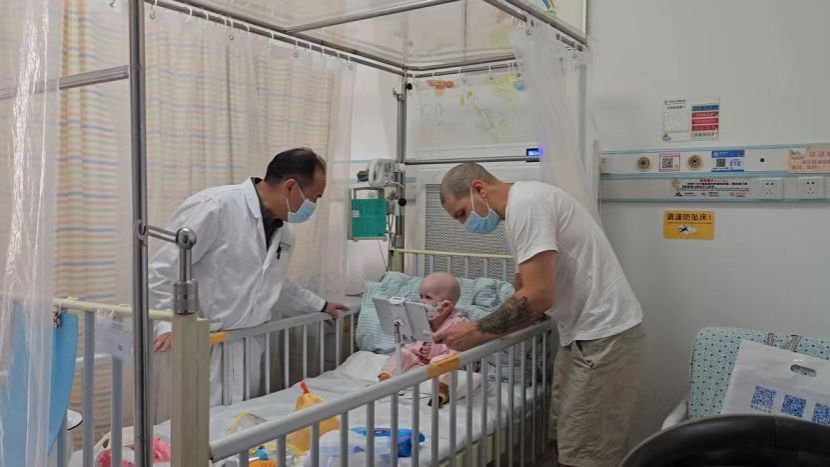
Dr. Jiang visits Alma in her hospital room.
"I searched the world for a doctor who could save my daughter, and ultimately, it was China that opened this door for us," said Alma's father, Macall. As a nurse, Macall noticed that when Alma started walking at 1 year old, she could not stand independently, had an unstable gait requiring assistance, and was lagging in language development. Following these observations, Macall took her for a check-up. In mid-May this year, Alma was preliminarily diagnosed with MLD at a local hospital in Sweden.
MLD is a rare hereditary metabolic disease caused by mutations in the arylsulfatase A (ARSA) gene, which leads to the accumulation of sulfatides in the brain and other parts of the body, resulting in neurological damage and functional degradation. Symptoms in MLD patients include a gradual loss of motor and cognitive functions, ultimately leading to death due to respiratory complications, infections, swallowing difficulties, and other related issues, with an expected lifespan of around five years for late-infantile patients.
With his background in healthcare, Macall reviewed extensive literature, seeking relevant treatment cases and medical trials. Unfortunately, clinical experiences with MLD treatment in Europe and the US are limited, and many hospitals declined to accept Alma due to financial considerations and uncertainties regarding treatment efficacy. Just when Macall felt as they had received a "death sentence," a glimmer of hope appeared. Professor Lian Qizhou from the Faculty of Synthetic Biology at Shenzhen University of Advanced Technology published findings on related therapy. In June, Macall reached out to Professor Lian via email. Thanks to his assistance, a rapid online evaluation of Alma's condition was conducted just 10 days later by Dr. Jiang Hua, the head of the Center, who provided an initial treatment plan.
The success of this treatment is attributed to China's advanced gene-modified autologous stem cell transplantation technology. Dr. Jiang, the attending physician, explained that traditional methods of "allogeneic hematopoietic stem cell transplantation" come with numerous challenges, including the potential worsening of the condition post-transplant, difficulties in donor selection, severe drug side effects, and high rejection risks. In contrast, gene-modified autologous stem cell transplantation significantly reduces the risk of infection and neurological damage, as long-term use of immunosuppressants is unnecessary.
Beginning on August 30, when Alma was first hospitalized, Dr. Jiang's team successfully reinfused gene-modified autologous stem cells into her body following the collection of her stem cells, central venous catheter placement, and myeloablative conditioning. On October 25, after monitoring her stable platelet count and confirming the absence of infection, she was discharged, completing the entire treatment process in just 29 days.
Dr. Jiang noted that earlier intervention is crucial, as neurological damage is irreversible. Fortunately, Alma has shown encouraging progress, such as being able to operate a mobile phone, an important indicator of her cognitive recovery. "Next, we will monitor her enzyme levels monthly to ensure they remain stable. If there are no abnormalities, the child will be able to return to society," he added.
"Alma was born again in Guangzhou, China," Macall said. According to him, her condition has significantly improved: Her previously drooping left eyelid and foot deformities are now being addressed, and her leg muscle strength has increased. He expressed deep gratitude toward the Chinese doctors for their exceptional care, which included not only medical treatment but also assistance with visa arrangements and ongoing communication throughout Alma's recovery. "I am incredibly thankful to everyone who helped Alma; They might be doctors and nurses at the hospital but at the same time they are miracle workers," Macall added.
Reporter: Zhang Wenya, Cheng Yuanzhou




 COPYRIGHT?1999-2017 , SUN YAT-SEN UNIVERSITY