At present, the frequency of flood disasters has increased sharply around the world, and the scope of disasters has expanded year by year, and it has become one of the most important agricultural disasters. Prolonged plant immersion in flood/flooded environments can lead to a significant decrease in rhizosphere oxygen content, resulting in hypoxic stress (hypoxia); Long-term flooding stress will also greatly reduce the light intensity of the plant environment, resulting in weak light stress. Therefore, low oxygen and weak light are the two key factors affecting the flooding adaptability of plants. Studies have shown that in the reoxygenation response of plants after flooding, light changes are an important reason for the accumulation of peroxides in cells and affecting the stress tolerance of plants. However, so far, the mechanism of how light regulates plant flooding and post-flooding reoxygenation response is unclear.
Professor Xiao's team from the direction of plant stress biology in the School of Life Sciences, Sun Yat-sen University has long paid attention to the molecular mechanism of plant hypoxia perception, signal transduction and reoxygenation response, especially the analysis of the mechanism of plant hormone methyl jasmonates by activating the biosynthesis of antioxidants, regulating the homeostasis of peroxides in the reoxygenation response, and improving the reoxygenation adaptability of plants. Earlier in 2022, Professor Xiao and Professor Laurentius A. C. J. Voesenek of Utrecht University in the Netherlands jointly wrote an invited review paper to systematically summarize the multiple challenges, coping strategies and signal regulation mechanisms faced by plants in the process of reoxygenation after flooding. This paper focuses on the interaction between various regulatory pathways of the model plant Arabidopsis thaliana and rice during the recovery period after flooding, and compares the reoxygenation response mechanism of plants and animals after hypoxia in detail, which provides new ideas for future research in this field. The paper was entitled "Multi-stress resilience in plants recovering from submergence", and was published in Plant Biotechnology Journal, on October 10, 2022.
In order to further explore the regulatory mechanism of light signal affecting the reoxygenation tolerance of plants, by using molecular genetics and biochemical analysis, Professor Xiao's team found that the protein stability of the key transcription factor MYB30 of Arabidopsis thaliana decreased significantly during flooding, but accumulated significantly during reoxygenation after flooding, and this dynamic change was regulated by the 26S proteasome pathway. Phenotypic analysis showed that myb30 mutants were unusually sensitive to flooding stress compared to wild types, while MYB30-OE overexpressed transgenic plants showed enhanced tolerance. In-depth analysis suggested that during the flooding process, the core regulator of light signal, COP1, and MYB30 directly interacted, ubiquitination modified and degraded MYB30 protein. During the recovery process after flooding, MYB30 interacts with the transcription factor MYC2 of the jasmonate signaling pathway to synergistically regulate the expression of downstream antioxidant-related genes VTC1 and GSH1, activate the biosynthesis of antioxidants ascorbic acid and glutathione, and thus improve the tolerance of plants to flooding stress. Further analysis revealed that the overexpressed transgenic plants of VTC1 and GSH1 significantly enhanced their tolerance to reoxygenation stress, and partially restored the phenotype of myb30 mutants that were hypersensitive to reoxygenation. This finding elucidates for the first time the mechanism of the integration of light signals by the molecular module of plant COP1-MYB30 to affect redox homeostasis in plant cells, thereby regulating plant flooding tolerance, and provides a new perspective for understanding the adaptive mechanism of plant hypoxia-reoxygenation reaction.
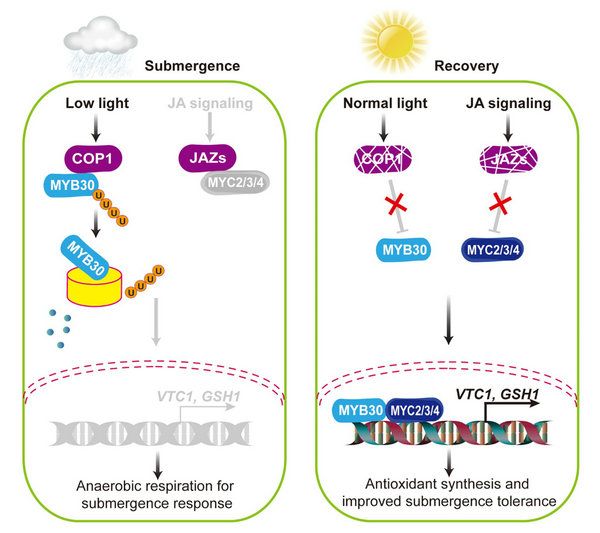
Figure 1. Working model showing the regulation of plant reoxygenation responses by COP1-MYB30 functional module.
This research article entitled "MYB30 integrates light signals with antioxidant biosynthesis to regulate plant responses during post-submergence recovery", was published online in New Phytologist on December 14, 2022. Dr. Xie Lijuan (associate professor of Guangdong Laboratory of Lingnan Modern Agricultural Science and Technology), PhD student Wang Jianhong and master student Liu Huishan are co-first authors, Professor Xiao Shi and Dr. Chen Moxian are co-corresponding authors, Professor Chen Yueqin and Professor Li Jianfeng of the School of Life Sciences, Sun Yat-sen University, and Professor Qiu Rongliang of South China Agricultural University also contributed to this article. The research from this project has been supported by the National Science Foundation for Outstanding Young Scholars, the National Natural Science Foundation of China, the Youth Science Foundation Project, and the Guangdong Provincial Key Field R&D Program.
Link to the paper:
https://onlinelibrary.wiley.com/doi/10.1111/pbi.13944
https://onlinelibrary.wiley.com/doi/10.1111/nph.18674




 COPYRIGHT?1999-2017 , SUN YAT-SEN UNIVERSITY