Prof. Zong-Wan Mao’s group at School of Chemistry made important achievements in the field of super-resolution imaging of platinum complex
Source: School of Chemistry
Edited by: Tan Rongyu, Wang Dongmei
In recent years, great progress has been made in understanding the intracellular behavior of platinum drugs. However, the commonly used visualization of intracellular platinum drugs are currently all using confocal microscopy, and thus it is difficult to achieve dynamic tracking of ultrafine structure. Among different microscopies for cell imaging, super-resolution microscopy provides a super-resolution imaging technique to break the optical diffraction limit, and realizes the super-resolution monitoring of the dynamic changes of organelles and drugs screening. It is of great significance to track the platinum drugs in real time with super-resolution to elucidate their dynamic behavior in live cells for drug development. However, it remains a challenge to design small molecular compounds with excellent photophysical properties that can be used for super-resolution imaging.
Recently, the research team of Professor Zong-Wan Mao at Sun Yat-sen University, the research team of Professor Jiajie Diao at the University of Cincinnati and the research team of Professor Vivian Wing-Wah Yam at the University of Hong Kong have collaboratively reported a binuclear platinum complex (Pt2L) for super-resolution imaging. The complex Pt2L has super-large Stokes Shift and excellent optical physical properties, which greatly reduces the background of super-resolution imaging. Meanwhile, the complex has high photobleaching resistance and can be tracked in live cells for a long time.
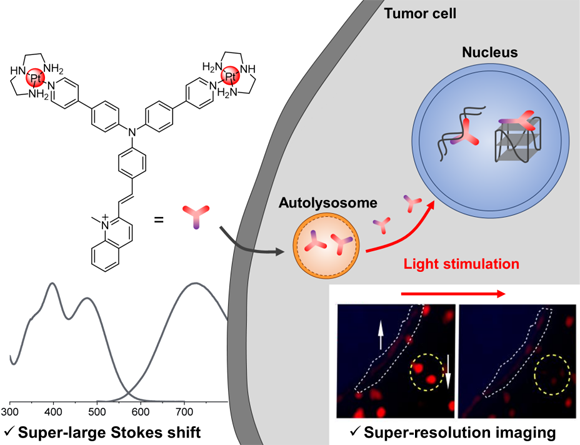
The complex Pt2L was mainly located in autolysosomes and has the potential to study the dynamic autophagy level through super-resolution imaging. In addition, upon light stimulation, the complex Pt2L can escape from autolysosomes to the nucleus and interact with the duplex and G-quadruplex DNA. Using super-resolution imaging, the escape path of platinum complex from autolysosomes to the nucleus was observed for the first time. Utilizing the photoactivated escape properties, we can regulate the nuclear accessibility of Pt2L form autolysosomes with photo-selectivity, which provides a new way to improve the targeting of platinum drugs.
This work not only provides super-resolution imaging of platinum complexes in live cells and the detection of autophagy changes, but also provides a new way to improve the targeting of platinum complex utilizing the photoactivated escape from autophagosomes to the nucleus. The research results have been published in
Angewandte Chemie International Edition (IF = 12.959) entitled “Multiple-Color Platinum Complex with Super‐Large Stokes Shift for Super‐Resolution Imaging of Autolysosome Escape”,
Angew. Chem. Int. Ed. 2020, 59, 19229-19236.
Liu-Yi Liu (Sun Yat-sen University), Hongbao Fang (University of Cincinnati), Qixin Chen (Shandong First Medical University), and Michael Ho-Yeung Chan (University of Hong Kong) is the first author. Professor Zong-Wan Mao (Sun Yat-sen University), Professor Jiajie Diao (University of Cincinnati), and Professor Vivian Wing-Wah Yam (University of Hong Kong) are the co-corresponding authors.
This work was supported by the National Science Foundation of China, the Ministry of Education of China, and the Fundamental Research Funds for the Central Universities.
Link to the paper:
https://doi.org/10.1002/anie.202007878





 COPYRIGHT?1999-2017 , SUN YAT-SEN UNIVERSITY