A new study led by Prof. Shangfei Liu unveils secrets of the formation of Jupiter’s large diluted core
Source: School of Physics and Astronomy
Written by: School of Physics and Astronomy
Edited by: Wang Dongmei
A head-on collision between the young Jupiter and another massive planetary embryo about 4.5 billion years ago could result in Jupiter’s puzzling large diluted core, previously discovered by NASA’s Juno spacecraft, according to a study published in
Nature on August 15, 2019. This work was accomplished by an international research team led by Prof. Shangfei Liu from School of Physics and Astronomy, Sun Yat-sen University.
An artist’s impression of a hypothesized collision between the young Jupiter and a massive planetary embryo about 4.5 billion years ago. Credit: Astrobiology Center, Japan
NASA’s Juno spacecraft has revolutionized our understanding of Jupiter in every aspect since it started to orbit the largest gaseous planet in our solar system on 5 July 2016. One of Juno’s major scientific goals is measuring Jupiter’s gravity field with an extraordinary precision. Models based on Juno’s data suggest that Jupiter has a fuzzy, extended core, with a few tens of Earth masses of heavy-element (other than hydrogen and helium) material distributed within a region extending to nearly half of Jupiter’s radius. “Such a large diluted core suggests that Jupiter’s deep interior is a mixture of heavy elements and a lot of hydrogen and helium and there is no distinct separation between the core and the gaseous envelope,” said the lead author Shangfei Liu, associate professor of School of Physics and Astronomy, Sun Yat-sen University.
"Jupiter’s bizarre interior gave planetary scientists a headache,” said Prof. Liu, “because in the standard picture of gas giant formation, Jupiter began as a rocky and/or icy planetary embryo and later gathered its massive hydrogen and helium gas envelope from the solar nebula.” The existence of a large diluted core is very hard to explain despite an initial compact core could have been partially eroded over billions of years. “When I first saw the results of such a large diluted core of Jupiter, I realized that something unusual must have happened to Jupiter in the past,” Prof. Liu recalled, “that’s how the giant impact hypothesis was proposed.”
Collisions between planets were common in the early days of our solar system. Our moon was formed after a giant impact between the proto-Earth and a Mars-sized planet. There are evidences suggesting that other planets also suffered giant impacts when they were formed. “Jupiter’s large diluted core might be the first concrete evidence that Jupiter once had a violent past,” said Prof. Liu. Using computer simulations, Prof. Liu and his colleagues find that an emerging Jupiter has a strong influence on nearby planetary embryos, which were heavily populated in the early solar system, and as a result there is at least a 40% chance that a planetary embryo could smack into Jupiter in a few million years after the formation of Jupiter. “Because Jupiter’s gravitational focusing effects are very strong, head-on collisions are more often than grazing ones,” said Prof. Shangfei Liu. The research team simulated various collision scenarios, and they found only head-on collisions with a planetary embryo about ten times as massive as the Earth can create a dilute-core-like structure inferred from Juno’s data. However, giant impacts are stochastic, and the outcomes depend on impactor’s mass and impact angle, etc. “This is a unique perspective to look at the origin of the dichotomy of interior structures of gas giant planets,” Prof. Liu said, “we are fortunate to have two gas giant planets in our solar system. Comparing Jupiter’s and Saturn’s interior structures can help us to understand their formation.”
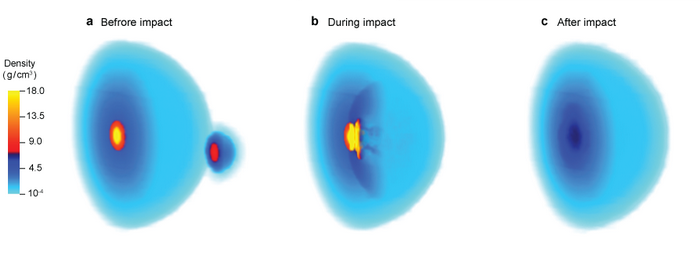
A head-on collision between the young Jupiter and a massive planetary embryo, which destroyed Jupiter’s primordial compact core and created a diluted core. Credit: Shangfei Liu.
Further investigations of the long-term thermal evolution suggest that such a large diluted core formed after the giant impact can persist over billions of years, i.e., the lifetime of the solar system. The head-on giant impact scenario is by far the best explanation for Jupiter’s diluted core according to the referee’s remarks.
This study also has implications for extrasolar planetary systems. Among thousands of exoplanets discovered, some of them have both measured mass and radius, so one can infer their mean densities. “We know some exoplanets are very dense,” Prof. Liu said, "they could have experienced giant impacts, so they lost a lot of light elements.”
Prof. Shangfei Liu is the lead author and corresponding author of this study. Additional co-authors include Yasunori Hori of the Astrobiology Center of Japan, Simon Müller and Ravit Helled of the University of Zurich, Xiaochen Zheng of Tsinghua University, Doug Lin of both the University of California, Santa Cruz, and Tsinghua University, and Andrea Isella of Rice University.
Article link:
https://www.nature.com/articles/s41586-019-1470-2





 COPYRIGHT?1999-2017 , SUN YAT-SEN UNIVERSITY